


Which Disability Benefit Is Harder to Get: SSDI or SSI?
by April L. Roberts | Dec 12, 2022

The government offers disability benefits for those suffering from severe physical or mental health impairments. When you are unable to work due to a disability, you can apply for Supplemental Security Income (SSI) and Social Security Disability Insurance (SSDI) through the Social Security Administration (SSA). When seeking benefits due to a disability, it’s essential to understand the difference between SSI benefits and SSDI. Here we compare the two federal benefits programs, how the Social Security Administration (SSA) determines your eligibility, and which disability benefit is harder to get – SSDI or SSI.
Difference in Benefits
Simply put, SSI is based on limited income and age, while SSDI is based on a change to your health that impacts your ability to work full-time.
What is Social Security Insurance (SSI)?
The SSI program is designed to assist older people and the disabled with financial assistance to supplement their limited income and resources. Those with disabilities can apply for SSI regardless of age. Disabled children can also receive benefits based on certain criteria. State programs often supplement federal SSI payments approved by the SSA.
What are Social Security Disability Benefits (SSDI)?
SSDI benefits are available to those with an established work history suffering from a disability that keeps them from working. Employment can be through an employer or self-employment. It is designed to protect people with physical or mental impairments who cannot perform work. Your Social Security tax contributions fund the benefits.
Qualifying for Benefits: SSI vs SSDI
You can apply for SSI regardless of age, previous employment history, and social security contributions. SSI is based on income level, which is adjusted each year. In 2022, income could not exceed $841 for one person or $1,261 per couple and includes any social security benefits you receive, pensions, supplements for shelter and food, part-time work, etc. Your assets can also not exceed $2,000 for one person or $3,000 for a couple, and you must also apply for any other Social Security benefits available to determine if you are eligible to receive further funding.
You can apply for SSDI benefits if your condition will last at least one year or result in death. However, to qualify, you must prove to the SSA your condition limits your ability to work and perform tasks such as lifting, standing, walking, sitting, logic, decision-making, etc. Your assets are not considered in the process, but your income, work history and skills are.
Is It Harder To Get SSI Or SSDI?
Most people who have been through the process will tell you SSDI is the harder of the two. Is it easier to get SSI or SSDI? It is very challenging to receive Social Security disability benefits, with only 34% of applicants approved in the initial application process. However, overall, 51% of applicants are approved for SSDI compared to just 36% for SSI. You can increase your chances of acceptance by working with a disability advocate who will ensure all the required information is submitted with your application.
At Princeton Disability, we understand the process and go the extra mile to avoid denial and delays. We use our own questionnaires to collect all the required information ahead of time and submit them with your application. As a result, the process is expedited by avoiding the time-consuming process involved when the SSA sends further forms and requests further tests and evidence. We establish the severity of your symptoms and demonstrate how they prevent you from performing basic work due to your condition so you qualify for the maximum benefit payout available and can start receiving disability benefits.
What Are The Chances Of Being Approved By The Social Security Administration?
Let’s take a look at how hard it is to get disability benefits based on the criteria for approval:
Technical Denials: SSI vs SSDI
Is it easier to get SSI or SSDI at the first step of the application screening process? More people are denied for SSDI at the first step based on non-medical criteria at 45% than SSI at 18%. Technical denials are mostly determined by income.
5-Step Medical Evaluation: Is SSI harder or SSDI?
41% of SSDI claims were approved based on medical criteria compared to 37% for SSI. The five-step medical evaluation is a rigorous process that looks at the severity of conditions and how those conditions impact your ability to work. If your condition is severe enough, they approve your claim. If the SSA is not convinced by your symptoms alone, they also assess your ability to do other work based on your past work history. Even then, if they find you can’t do past work, they look at the potential to hold other jobs based on your skill level. They create a Residual Functional Capacity (RFC) and look at vocational factors to determine your work capacity.
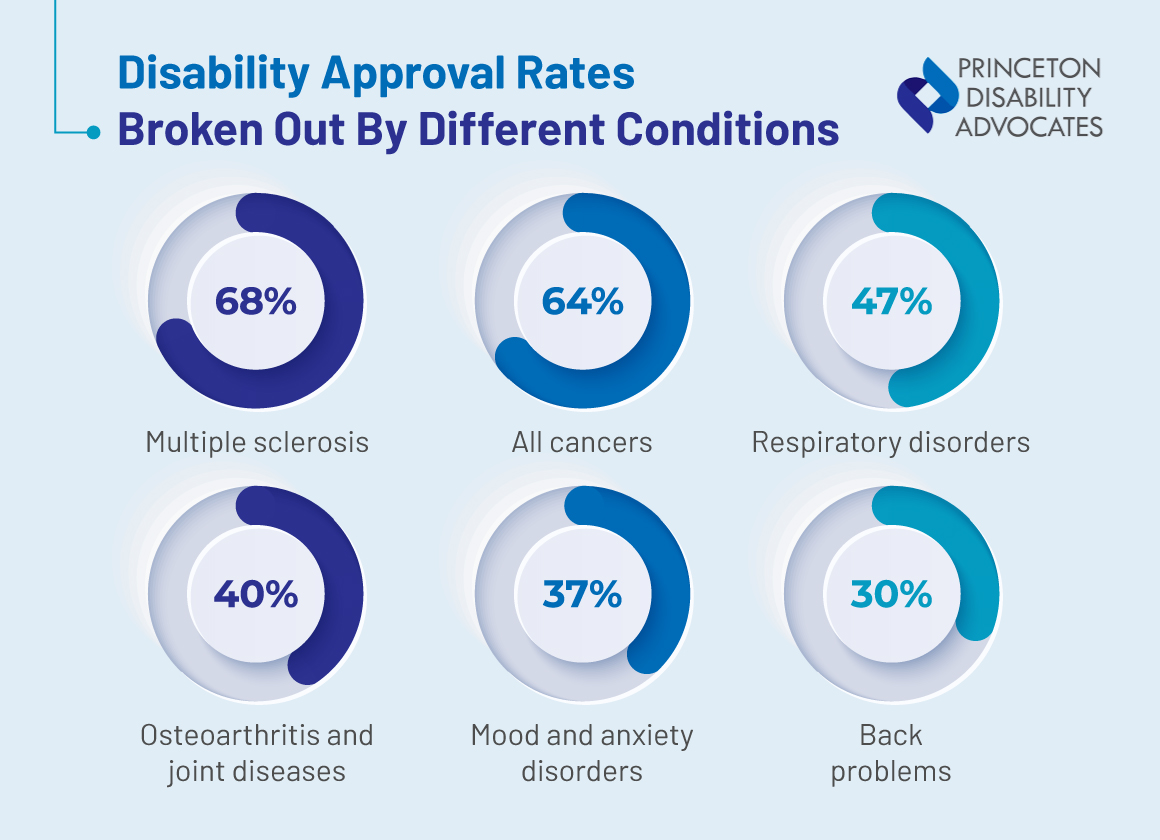
Disability Approval Rates Broken Out By Different Conditions
Here are SSDI approval rates by condition:
- Multiple sclerosis 68%
- All cancers 64%
- Respiratory disorders 47%
- Osteoarthritis and joint diseases 40%
- Mood and anxiety disorders 37%
- Back problems 34%
Quit Work Date Approval Rates
It makes a difference whether you are still working when applying for benefits. For example, 29% who applied for benefits were approved while still working compared to those who applied less than 150 days from their quitting dates at 51%. Interestingly only 36% of those who applied more than 150 days after quitting were approved. SSA examiners and judges give preference to those with a steady, longer history of work than those who have experienced long periods of unemployment.
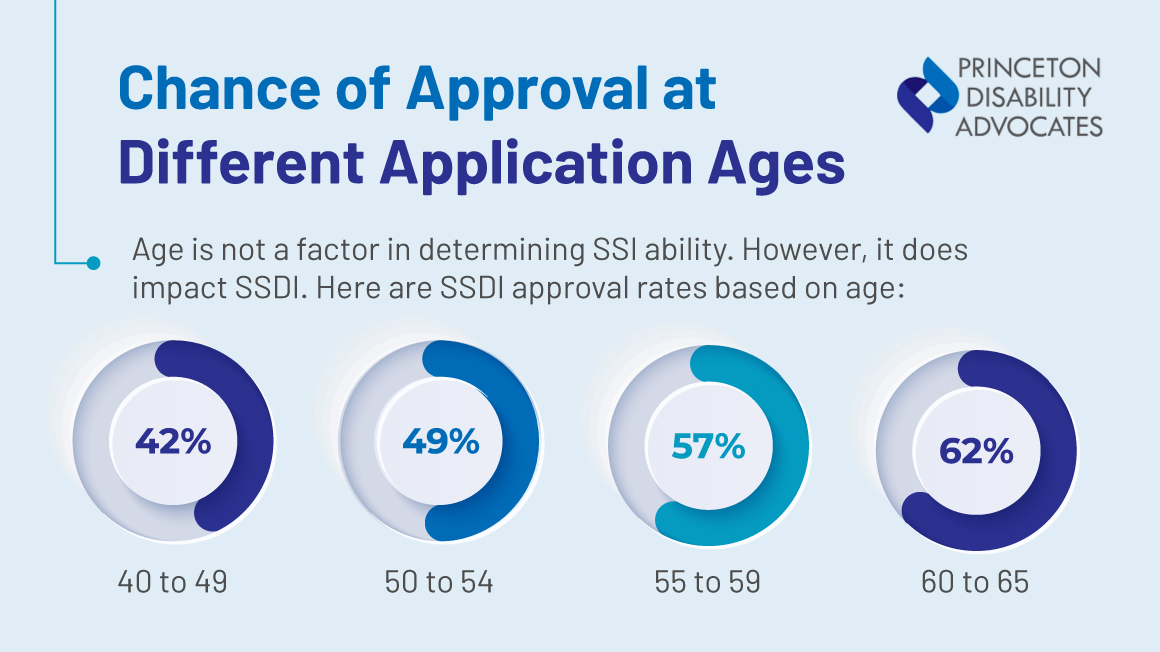
Chance of Approval at Different Application Ages
Age is not a factor in determining SSI ability. However, it does impact SSDI. The younger the applicant, the lower the approval rates. This ties directly to the fact medical conditions tend to deteriorate with age. Here are SSDI approval rates based on age:
- 40 to 49: 42%
- 50 to 54: 49%
- 55 to 59: 57%
- 60 to 65: 62%
Percentage of Benefits Approval By Gender
Last on our list of comparisons, we see slightly more females applying for SSI at 14% compared to men at 11%. This most likely relates to the fact that close to 80% of men are insured for SSDI compared to 70% of women causing more women to have to apply for SSI.
There is also a distinct gap between approval rates based on gender, with male approval rates at 44% and female approvals at 38%. When we look at the type of medical conditions, however, there are also marked differences. There are more women with mental conditions or musculoskeletal impairments, yet more men suffer from respiratory problems, injuries, and cardiovascular disease. Male dominant conditions tend to have above-average approval rates, which accounts for some of the disparity.
Easiest State To Get Disability
In 2015, Hawaii had a 67% approval rating, making it the easiest state to get disability benefits. Interestingly it is also the state with the lowest percentage of disabled citizens.
When Should I Consult With a Disability Advocate?
The sooner you consult with a disability advocate, the sooner your application will be complete, and the higher chance there is for approval. Two-thirds of disability claims are denied when filed without assistance from a disability advocate. As well, benefits of up to $3,345 per month are available to qualified applicants. Now is the time to choose an advocate.
At Princeton Disability Advocates, we understand the system and will take all necessary steps to prove you are eligible to receive the highest possible amount of disability benefits. Click here to set up your free consultation today.