


How Social Security Evaluates Disability Claims: Phases of the Disability Process
by April L. Roberts | Nov 9, 2022

The social security disability evaluation process is quite intense for your initial application. When submitting your disability application, you must include detailed medical criteria to ensure your disability determination confirms your eligibility. The Social Security Administration (SSA) uses a series of questionnaires, a functional assessment, and a “Blue Book” of medical listings to determine if your impairment meets the criteria to receive benefits. They follow five disability process steps to confirm you are eligible for social security benefits. Here we walk you through the SSDI review process so you understand how the SSA reaches your initial determination.
The 5-Step Sequential Evaluation Process: How Social Security Determines the Approval of Your SSI or SSDI Claim
There are five phases in the disability process. However, your disability determination is subject to not just phases but the evaluation of key players involved in the decision-making process. Throughout each phase, an “adjudicator” carefully reviews your application to decide whether you meet that phase’s criteria. The players include:
- Disability Determination Service (DDS) Examiner: This adjudicator works with a DDS Physician and is involved in the Initial Application and Reconsideration phases.
- Administrative Law Judge: During the Hearing phase, an Administrative Law Judge works with a Medical Expert (ME) to decide whether the initial decision to deny your claim is to be confirmed or to approve the claim based on new evidence presented.
Using a disability advocate helps ensure you avoid the involvement of an administrative law judge.

Phases of Disability Process
Here are the phases of the disability process steps followed before your disability determination is made:
Step 1: Non-Medical Criteria
Although your claim depends on your medical condition, the SSA first considers non-medical criteria before you can proceed to the next step. Non-medical criteria include:
- Substantial Gainful Activity (SGA) level: The SGA considers how much you can earn based on your current condition. This amount changes yearly, and you cannot make more than the maximum amount to qualify. If you reach more, your application is automatically denied.
- Proof of Age: Age is considered as you have to work a certain amount of time to qualify for benefits. A copy of your birth certificate confirms your age, although the SSA can look up your Numident file. It’s always best to provide information to avoid delays. Applicants over 50 are more likely to qualify than younger people. The SSA views older people as less likely to be retrainable or hirable in new positions than their younger counterparts.
- Social Security Disability Insurance Coverage: This information tells the SSA your work history and how much you have contributed to FICA premiums. SSA uses this amount to determine your eligibility and the number of benefits you can receive based on how many of the past ten years you’ve worked.
- Your employment information: This includes your employment history, earnings, and the relevant work you have performed. The type of work you do tells the adjudicator if your skills are transferable to other jobs as opposed to receiving benefits.
- Marital status: This simply helps determine your household income to establish the payable amount of benefits you can receive.
If you fail to meet the non-medical criteria, your application is denied. Unless the information provided here is incorrect, an appeal will not be approved.
Step 2: Level of Impairment
Through the phases of the disability process, you are scrutinized for medical and non-medical criteria. If you pass Step 1, the second phase looks at your level of impairment. The SSA uses a listing of impairments to determine if your disability is severe enough to make it impossible for you to work. Medical evidence is crucial at this phase as it supports your claim and proves your impairment level.
Although you might have a listed impairment, the evidence is reviewed to show exactly how your condition impacts your ability to perform your current role and other possible jobs. The adjudicator reviews your evidence and decides if they should instigate further steps to confirm your impairment, including:
- Activities of Daily Living and Vocational Questionnaire: This is where things can get tricky, as how you answer the questions impacts your approval. At Princeton Disability, we have our clients complete our version of these forms so we can submit the information to the SSA with your initial application. Because we understand the phases of the disability process, we can walk you through each question and ensure the answers describe how your symptoms impact your ability to perform everyday tasks.
- Consultative Examination (CE): Can you get evaluated for disability? Absolutely. Your adjudicator might decide to have a CE with a doctor contracted by DDS to assess your condition. During the CE, the assigned examiner reviews your medical history, discusses your complaints, and conducts a physical examination. The DDS can also request certain tests are carried out during your CE.
The evidence is reviewed to confirm the following:
- Your symptoms limit your ability to perform basic work activities
- Physical limitations based on whether you can walk, stand, lift, push, carry things, etc.
- Cognitive limitations including the inability to speak, hear, see, concentrate, follow basic instructions, get along with co-workers, etc.
If the SSA finds the severity level meets their criteria, you can proceed to the next step. If not, your claim is denied. At this phase, you can proceed for review with an appeals council. A disability advocate is highly recommended to ensure your appeal is not denied.
Step 3: Medical Listings
Although your medical evidence has just proven you suffer from a severe impairment, the SSA confirms you have a listed impairment at the third phase. Social Security looks at listings both physically and mentally under the following categories:
- Musculoskeletal System (Listing 1.00)
- Special Senses and Speech (Listing 2.00)
- Respiratory System (Listing 3.00)
- Cardiovascular System (Listing 4.00)
- Digestive System (Listing 5.00)
- Genitourinary Impairments (Listing 6.00)
- Hematological Disorders (Listing 7.00)
- Skin Disorders (Listing 8.00)
- Endocrine Disorders (Listing 9.00)
- Impairments that Affect Multiple Body Systems (Listing 10.00)
- Neurological Impairments (Listing 11.00)
- Mental Disorders (Listing 12.00)
- Malignant Neoplastic Diseases (Listing 13.00)
- Immune System Disorders (Listing 14.00)
If your impairment is confirmed, you are considered disabled, and your claim is approved. The SSA might also decide that although you don’t have an exact condition on the listings, your impairment is considered to “equal a listing” based on the medical evidence you present. If you do not meet the listing requirements, you proceed to the next step.
Step 4: Ability to Work
The SSA adjudicator’s job at this phase is to determine your Residual Functional Capacity (RFC) and ability to perform a substantial gainful activity (SGA). Here they consider all impairments and symptoms to estimate your ability to perform standard functions required to work full time. There is a physical and mental assessment to consider physical tasks like sitting or standing for long periods, walking, or lifting and cognitive functions such as remembering, understanding, abstract thinking, etc. For example, you might be able to stand for 4 hours, but your job requires you to stand for eight. Your job might be sedentary, but your condition makes sitting difficult after two hours.
You might need to remember several steps to perform tasks, but your condition causes brain fog, memory loss, or difficulty concentrating. During the disability determination process, you have the right to request your own doctor complete the Residual Functional Capacity (RFC) assessment through your disability advocate. Keep in mind claims handled by disability advocates are more likely to win approval. Otherwise, the DDS will complete the RFC based on your medical records.
RFC Categories
Your assessment determines your RFC category:
- Sedentary
- Light
- Medium
- Heavy
- Very Heavy
Heavy or very heavy categories mean you won’t qualify for SSDI unless you can prove you have other limitations. This might include back conditions, for example. When applying for SSDI, a disability advocate considers every aspect of your medical and physical health history to ensure the adjudicator understands all health issues contributing to your ability to work.
Past Relevant Work (PRW)
They also assess your PRW to determine which of the following categories your skills fall into:
- Skilled: The highest level of training or elevated education requiring licenses and/or complex abstract thinking.
- Semi-Skilled: Mid-level training with education preferred but not required but with the need for attentiveness and awareness.
- Unskilled: Little to no training or education with rare reasoning required.
PRW helps determine if you have skills you can apply to new positions or for retraining. If the adjudicator determines you can’t perform the functions required in your past work, you will be found disabled. They will move on to the final step if they are uncertain whether you can transfer your skills to another job.
Step 5: Potential to Perform Other Work
This is your last chance to prove you are unable to work either mentally or physically. At this point, the adjudicator looks at other vocational factors in hand with your PRW to determine if you can perform different types of work, including:
Age
Age is categorized as follows:
- Younger: 18 to 49
- Closely Approaching Advanced Age: 50 to 54
- Advanced Age: 55 to 59
- Closely Approaching Retirement: 60 and older
As mentioned in Step 1, although age alone is not a determiner, the SSA does consider those over 50 less likely to adjust to new work following training.
Education
Education categories include:
- Illiterate: Unable to read or write.
- Marginal Education: Formal education up to grade six.
- Limited Education: Formal education up to grade 11.
- High School Education and Above: Formal education up to grade 12 or earned a GED or equivalent.
Although Step 4 confirmed you couldn’t perform your past work, the SSA wants to establish whether your skills and abilities allow you to take on a new job. Your claim can be approved if they determine your skills are not transferable. However, if they find you can perform work in a new capacity, your claim is denied and must go through the appeal process.
How Do I Apply for a Disability Claim?
You can apply for SSDI online, at the local SSA office, or by calling 1-800-772-1213 (TTY 1-800-325-0778). A disability advocate can get the process started and ensure every step is followed to avoid denial and the need for appeal.
Should I Consider Getting Professional Help?
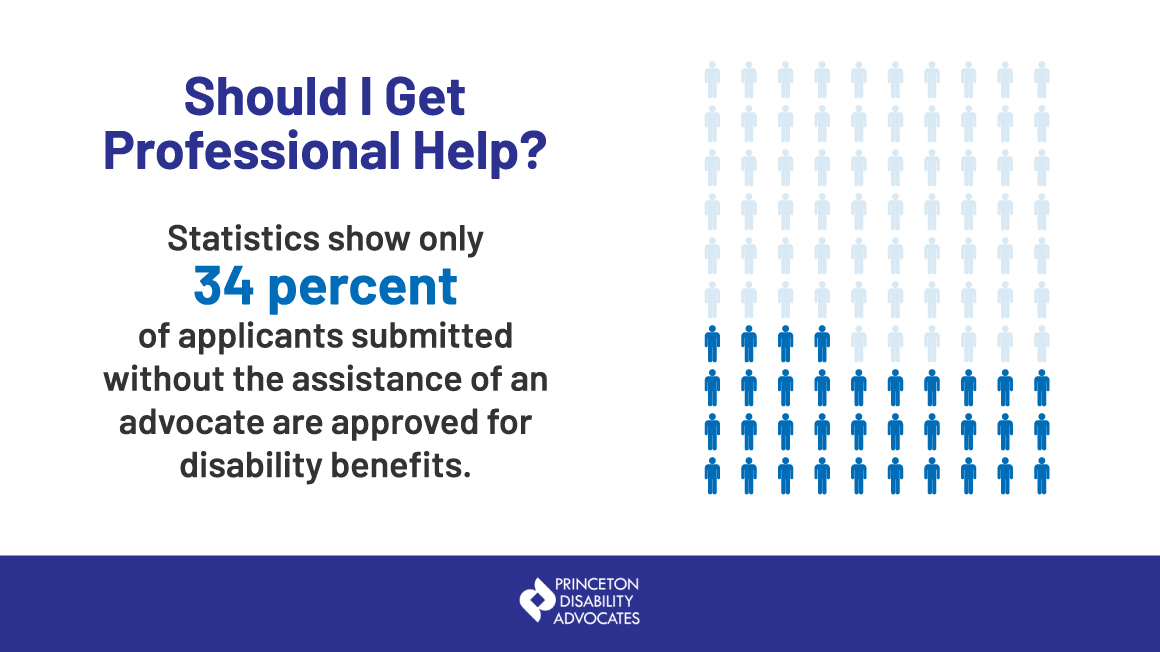
Because only 34 percent of applicants who submit without the assistance of an advocate are approved for disability benefits, it makes sense to seek professional help. When you work with our team at Princeton Disability Advocates, you’ll be able to take advantage of our experience and industry-leading service to get the results you need. In fact, you won’t have to pay a penny unless your case is won. Get in touch with us today to set up a free consultation to get the process started.